AP Cybersecurity is the College Board's newest AP course. It piloted in 2025-26, launches nationwide in fall 2026, and holds its first AP exam in May 2027. Schools across the country are deciding right now which AP Cybersecurity curriculum to adopt, and the choice matters: the right platform determines whether your students just read about security or actually practice it.
In this guide, we break down what the AP Cybersecurity course and exam look like, what to demand from an AP Cybersecurity curriculum, and how JuiceMind's AP Cybersecurity curriculum compares to alternatives like CodeHS and UTeach, so you can pick the best fit for your high school classroom.
What Is AP Cybersecurity?
AP Cybersecurity is a yearlong AP course for high school students, part of the College Board's AP Career Kickstart program, which connects AP coursework with career and technical education. Students learn to secure physical spaces, networks, devices, applications, and data using defense-in-depth strategies.
The course framework spans five units and spirals three exam-weighted skill categories throughout:
- Analyze Risk: Identify vulnerabilities, threats, and attack methods, then evaluate their likelihood and impact.
- Mitigate Risk: Select and evaluate layered security controls.
- Detect Attacks: Interpret logs, indicators of compromise, and system behavior.
A fourth skill, Collaborate, has students work in teams and use AI responsibly on cybersecurity problems. Enrollment is wide open, too: AP Cybersecurity has no prerequisites, and students don't need any prior programming experience. The College Board recommends basic computer literacy, nothing more. That makes it one of the most accessible AP STEM courses a high school can offer, and the early numbers back that up: the 2025-26 pilot reached about 3,100 students at 183 schools in 30 states, with hundreds more schools signing on for the nationwide launch.
Students who earn qualifying scores could receive college credit toward a certificate, community college, or four-year program, plus an employer-endorsed AP Cybersecurity Credential aligned with industry certifications like CompTIA Security+ and Cisco CCST: Cybersecurity.
The AP Cybersecurity Exam: Format and Dates
The first nationwide AP Cybersecurity exam takes place in May 2027. It is fully digital, administered through the College Board's Bluebook app, and consists of two sections:
- Section I: 60 multiple-choice questions in 80 minutes, worth 70% of the exam score
- Section II: 1 free-response question in 50 minutes, worth 30% of the exam score
The free-response question deserves a closer look, because the College Board has already published what it will hand students: several sources of information from a single device, including a set of firewall rules, system and application logs, a list of files with their permissions, and a device policy. Students have to find signs of an attack in the logs, explain parts of the policy, configure permissions and firewall rules, and suggest ways to harden the device.
Every question maps back to the three skill categories: analyzing risk, mitigating risk, and detecting attacks. That's why realistic scenario practice needs to be built into your curriculum from day one, not bolted on in April.
What to Look For in an AP Cybersecurity Curriculum
Whichever provider you pick, and whether you call it an AP Cybersecurity curriculum or just an AP Cyber curriculum like half the teachers in CS Facebook groups do, the same checklist applies:
- Framework alignment you can actually inspect. The provider should map its content to the College Board's five-unit framework and let you click through real lessons before you commit, not after a sales call.
- A day-by-day pacing guide. A topic list is not a curriculum. You want to know what happens on day 37.
- Scenario practice that mirrors the FRQ. Students should regularly read logs, reason about firewall rules, and defend security decisions in writing.
- Built-in assessment. Topic quizzes and unit exams aligned to the framework, so you're not writing tests for a course you've never taught.
- Support for non-specialist teachers. Nearly everyone teaching AP Cybersecurity this year is teaching it for the first time. A good curriculum assumes that.
Inside JuiceMind's AP Cybersecurity Curriculum
JuiceMind's AP Cybersecurity curriculum is aligned to the College Board framework and built as a repeatable classroom system, not a pile of PDFs. The live curriculum currently covers Units 1-4 across 18 topic sequences and 117 published lesson items, with Unit 5 coming soon:
- Unit 1: Introduction to Security covers social engineering, suspicious logins, public networks, and AI-based attacks and defense (about 10 class periods)
- Unit 2: Securing Spaces looks at physical vulnerabilities and how to protect and monitor physical environments (about 21 class periods)
- Unit 3: Securing Networks digs into network attacks, wireless security, segmentation, and firewalls (about 26 class periods)
- Unit 4: Securing Devices covers authentication, device hardening, malware, and identifying compromised devices (about 23 class periods)
- Unit 5: Securing Applications and Data, covering cryptography, access controls, and application security, is coming soon (about 30 class periods planned)
Every topic follows the same rhythm: short concept lessons, a ready-to-teach presentation, a review, an applied exit activity where students defend a real security decision, and a topic quiz. A 110-day pacing guide designed for 45-minute periods holds it all together. You can download the full AP Cybersecurity syllabus (PDF) to see the whole plan.
Applied Simulations That Mirror the FRQ
Reading about phishing is not the same as catching a spoofed login page. JuiceMind's simulation library drops students into realistic scenarios where they make a security decision and then have to defend it:
- Website Spoofing Simulation: inspect a cloned login page and pick out the phishing, credential-theft, and URL warning signs
- Deepfake Defense Mission: evaluate AI impersonation and phishing risks, then recommend layered defenses
- Segment the Hospital Network: apply segmentation, DMZ, VLAN, subnet, and firewall concepts to a network where downtime actually matters
- Build Your Own Firewall Rulebook: turn firewall and access-control-list concepts into a defensible set of traffic rules
- Malware Triage Center: assess signs of device compromise and choose protection and response steps
- Forensic Log Investigator: use authentication logs and indicators of compromise to classify suspicious activity
Look back at what the FRQ hands students: firewall rules, logs, file permissions, a device policy. These simulations work the same material. A student who spends the year doing this is practicing for the exam without anyone calling it exam prep. And for days when you want the class off screens entirely, the curriculum includes unplugged activities built for whole-group discussion.
Practice in a Real Linux Cyber Range, Right in the Browser
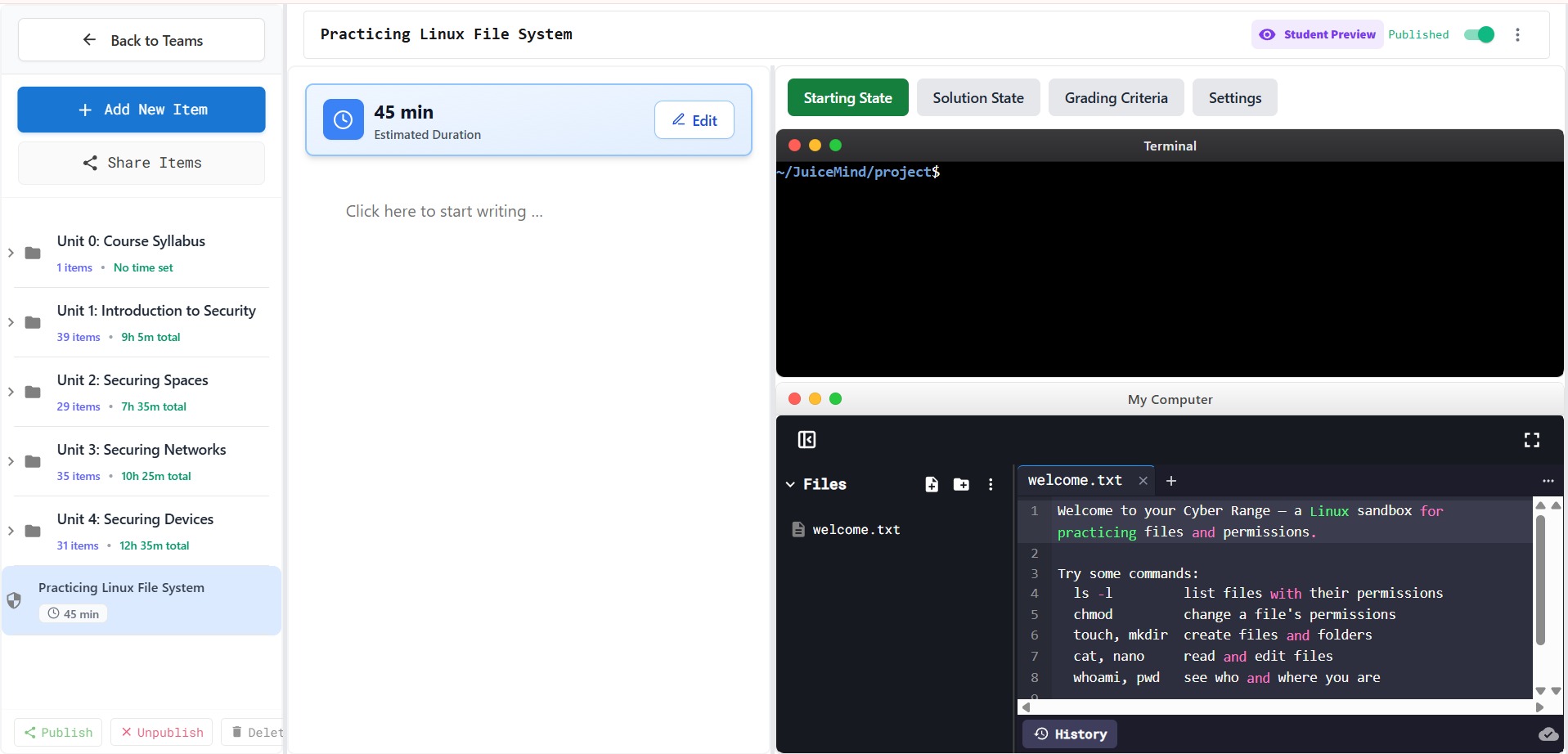
Reading about file permissions is not the same as setting them. That's why JuiceMind includes a cyber range: a sandboxed Linux environment that runs entirely in the browser.
Inside the cyber range, students work on a real Linux system. They create users and groups, lock down file permissions, inspect running processes, explore networking tools, and dig through authentication logs to hunt for indicators of compromise. Those are precisely the skills the FRQ tests when it asks students to configure permissions and find attack signs in logs, and it's the hands-on layer behind the course's Detect Attacks skill.
- Nothing to install. No virtual machines, no IT tickets, no local setup. Every student gets an isolated Linux environment in one click.
- Chromebook-friendly. If it runs a browser, it runs the cyber range, which makes it practical for 1:1 device programs.
- Safe by design. Environments are sandboxed and isolated, so students can experiment freely without touching school infrastructure.
AP Cybersecurity Practice Tests and Exam Prep
JuiceMind builds assessment into every topic instead of saving it for exam season:
- 18 topic quizzes aligned to the framework, one per topic sequence.
- Unit exams, with Unit 1 already shipping two full exam versions for secure re-testing.
- JuiceMind Quizzes, a Kahoot-style live quiz platform your whole class can play, with question types that go beyond multiple choice.
- AI-assisted grading for written responses, so free-response practice doesn't bury you in grading.
JuiceMind vs. CodeHS vs. UTeach: Choosing an AP Cybersecurity Provider
Several strong providers are launching AP Cybersecurity curriculum for 2026-27. Here's how the main options stack up at a glance.
| JuiceMind | CodeHS | UTeach | |
|---|---|---|---|
| College Board framework-aligned | ✓ | ✓ | ✓ |
| Browser-based Linux cyber range | ✓ | ✓ | — |
| Topic quizzes & unit exams built in | ✓ | ✓ | Limited |
| Live quiz games (Kahoot-style) | ✓ | — | — |
| AI-assisted grading of written responses | ✓ | — | — |
| Group projects & collaboration | ✓ | — | ✓ |
| Full student history & plagiarism flags | ✓ | ✓ | — |
| Professional development | Onboarding + 24-hr support | Yearlong cohort (paid) | University-backed PD |
| Pricing | Free tier + school plans | Pro license per school | School subscription |
JuiceMind
Everything in one K-12 platform: lessons, presentations, cyber range, quizzes, exams, live games, and AI grading.
Best for: teachers who want the whole course ready to run, even without a security background.
Consider: focused on K-12, not higher ed.
CodeHS
A general-purpose CS platform that also offers an AP Cybersecurity course.
Best for: schools already locked into the CodeHS ecosystem.
Consider: the meaningful parts (labs, grading tools, PD) require paid per-school Pro licensing, and there are no live quiz games or group projects to keep students engaged.
UTeach (with Teach Cyber)
Project-based curriculum from UT Austin framed by a fictional hacker-group narrative, with university-backed PD and year-round support.
Best for: schools that value narrative projects and strong PD.
Consider: curriculum and PD rather than an integrated platform, with no built-in IDE, live quizzes, or automated grading.
Other options worth knowing: Paradigm Cyber Ventures is a College Board national curriculum partner for AP Cybersecurity, and PLTW offers a broader CS pathway if you're building a multi-course program. You can explore JuiceMind's live AP Cybersecurity curriculum right now, no sales call required. It's the fastest way to compare for yourself.
AP Cybersecurity FAQ
When does AP Cybersecurity launch?
The course piloted at select schools in 2025-26 and launches nationwide in fall 2026. The first AP Cybersecurity exam is in May 2027.
Does AP Cybersecurity have prerequisites?
No. The College Board designed it as a foundational course, so no prior computer science coursework is required. Basic computer literacy helps, but that's it.
Is "AP Cyber" the same course as AP Cybersecurity?
Yes. Teachers and students shorten the name to AP Cyber all the time, but there's only one course behind it: the College Board's AP Cybersecurity, first offered nationwide in 2026-27.
What's on the AP Cybersecurity exam?
60 multiple-choice questions (80 minutes, 70% of the score) and one free-response question (50 minutes, 30%), fully digital through Bluebook. Questions assess analyzing risk, mitigating risk, and detecting attacks.
Are there AP Cybersecurity practice tests?
Yes. JuiceMind includes 18 topic quizzes, applied exit activities, and unit exams (Unit 1 ships with two versions), plus live review games through JuiceMind Quizzes.
Can I teach AP Cybersecurity without a cybersecurity background?
Yes. JuiceMind's structured topic sequences, teacher presentations, pacing guide, and AI-assisted grading are designed so teachers don't have to build the course from scratch.
Does AP Cybersecurity count for college credit?
The College Board says students with qualifying scores could earn credit toward certificate, community college, and four-year degree programs. They also earn the employer-endorsed AP Cybersecurity Credential, aligned with certifications like CompTIA Security+ and Cisco CCST: Cybersecurity.
Get Started for 2026-27
AP Cybersecurity is the biggest new opportunity in high school computer science in years: a no-prerequisite AP course feeding one of the fastest-growing career fields. If you're evaluating curriculum for next year, start with the one you can actually open and inspect today: explore the live JuiceMind AP Cybersecurity curriculum or visit the AP Cybersecurity course for high school page to download the syllabus and request access for your school.
One last practical note. JuiceMind isn't a single-course tool: teachers use it as a full coding platform for high school CS classes, with AP Computer Science A, AP CSP, Python, and web development running on the same student accounts. If AP Cybersecurity goes well, adding the next course doesn't mean adding another platform.